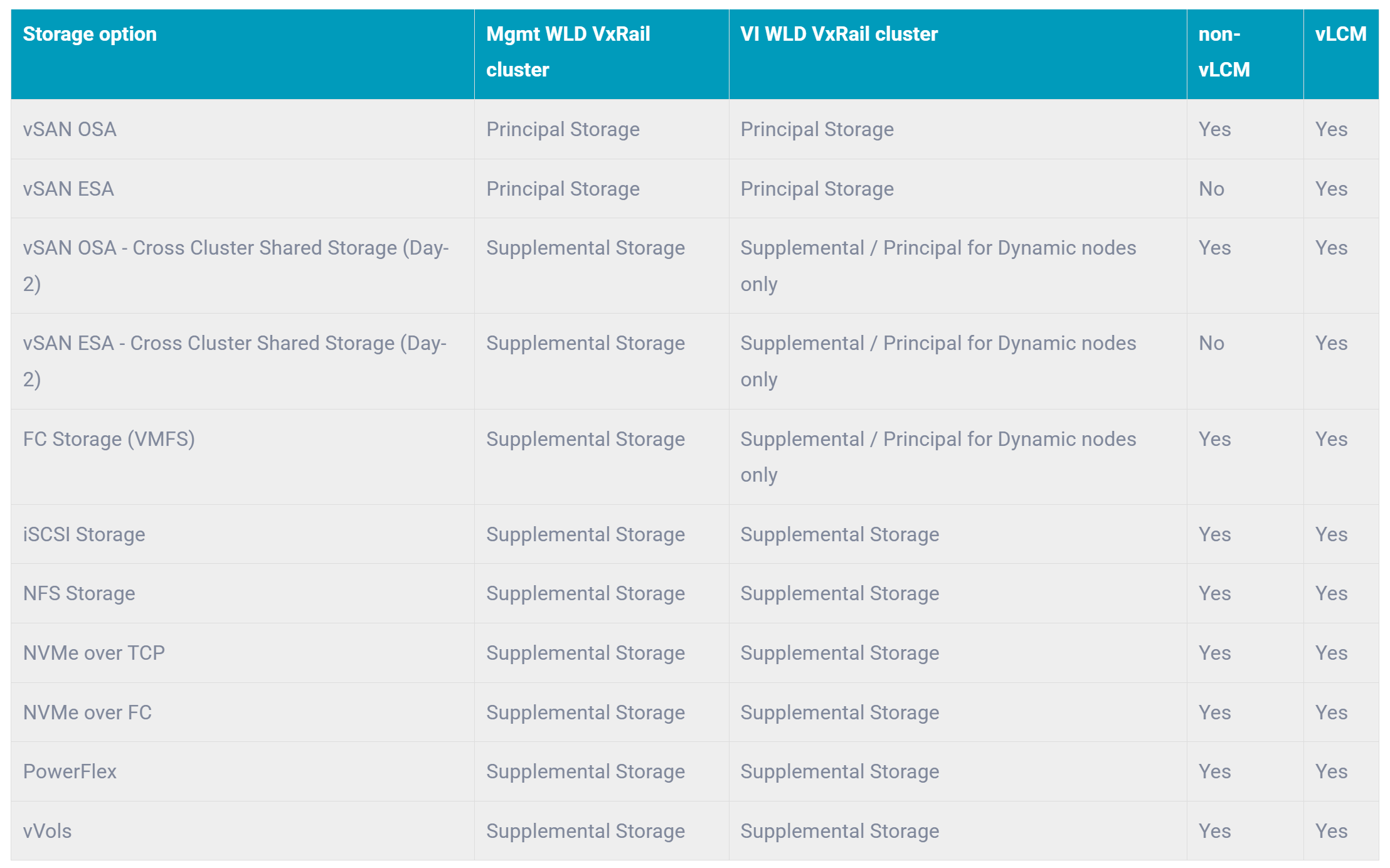
This post aims to highlight the storage flexibility offered by ‘VMware Cloud Foundation (VCF) on VxRail’. Here’s a summary of the storage options:
- Principal Storage Options:
- For the VI (Virtual Infrastructure) WLD (Workload Domain), both vSAN and Fibre Channel storage can be used as principal storage options. This flexibility was introduced in VCF version 4.3.1.
- However, for the Management WLD primary VxRail cluster, vSAN storage remains the mandatory principal storage option.
- Supplemental Storage Options:
- iSCSI, NFS storage, vVOLS, and vSAN HCI Mesh can be utilized as supplemental storage for both the Management and VI WLDs. This means they can complement the principal storage solutions mentioned above, providing additional storage capacity or serving specific use cases within the environment.
Overall, this approach provides administrators with a range of storage options to tailor the infrastructure to their specific requirements, balancing performance, capacity, and compatibility considerations across different workload domains.
Here’s a breakdown of the options:
- vSAN: Both the Management WLD VxRail cluster and the VI WLD VxRail cluster support vSAN as principal storage.
- vSAN HCI Mesh (Cross Cluster Shared Storage): This option is not available for the Management WLD VxRail initial primary cluster hosting managment VMs but can be used as supplemental storage for subsequent secondary clusters in the Mgmt WLD. vSAN HCI mesh datastores can be used as supplemental storage for the VI WLD VxRail clusters. VCF 5.1 introduced support for the use of HCI Mesh as principal storage in the case of VxRail dynamic nodes VI WLD clusters, created running the WFO API script method on SDDC Manager.
- FC Storage (VMFS): This option is available as supplemental storage only for the Management WLD VxRail cluster, but it can be used as principal storage for the VI WLD VxRail cluster, specifically for dynamic nodes (Support for 2-node Dynamic-node clusters introduced in VCF 5.1). Examples of VMFS on FC external storage include Dell PowerMax, VMAX, PowerStore-T, and Unity XT.
- iSCSI Storage: Available as supplemental storage only for both the Management and VI WLD VxRail clusters.
- NFS Storage: Similar to iSCSI, NFS storage is available as supplemental storage only for both Mgmt & VI WLD clusters.
- NVMe over TCP: This option is available as supplemental storage only for both Mgmt & VI WLD clusters.
- NVMe over FC: Supplemental storage only for both Mgmt & VI WLD clusters.
- PowerFlex: Also available as supplemental storage only for both the Management and VI WLD VxRail clusters.
- vVOLS: Supplemental storage only for both Mgmt & VI WLD clusters.
In a VCF consolidated architecture where a second or additional VxRail cluster is added to the Management WLD, it would have the same support as a VI WLD VxRail cluster. The use of supplemental storage for consolidated architecture follows the same guidelines as for the Management WLD VxRail Cluster.
As of VCF 5.1:
- VMware vSAN ESA is supported for both Management & VI Workload Domain clusters (vSAN ESA requires vLCM). vSAN ESA is designed as a single-tier architecture built on NVMe platforms. VCF On VxRail ESA stretched clusters are not supported. A WLD can have both ESA cluster(s) and OSA based cluster(s) provided vLCM is enabled for both ESA and OSA clusters.
- Dynamic Node 2-node clusters are supported with Fibre Channel LUNs/datastore as primary storage for the cluster (requires vLCM).
- vSAN HCI Mesh VCF 5.1 introduced support for the use of HCI Mesh as principal storage in the case of VxRail dynamic nodes VI WLD clusters, created running the WFO API script method on SDDC Manager. This requires that there is an existing vSAN cluster in the WLD.
Please reference the official VCF On VxRail Architecture Guide here.
NOTE: Support for vSAN ESA Stretch Clusters with the minimum code version being VCF 5.2.1.1



 DavidRing.ie