Introducing VCE VxRAIL

A Quantum Leap in Hyper-Converged Appliances

EMC|VCE and VMware have added a Hyper-Converged Infrastructure Appliance (HCIA) offering named VxRail to the existing CI portfolio of Vblocks, VxBlocks, VxRacks  (Blocks,Racks,Appliances).  


Vxrail1VxRail is built on a modular scale out clustering architecture that comprises of appliances (Base building block) where each appliance can house up to 4x industry standard x86 hardware compute nodes (four independent ESXi hosts) inclusive of storage. The appliance has a small footprint which is consuming only two rack units ‘2U’ in height, thus we will use the term ‘2U4N’ as abbreviation for the rack space and compute node count within the appliance. With the initial launch (Q1 2016) VxRail will have the ability to scale up to 8x appliances allowing for a total of 32x compute nodes (the Q2 VxRail release will allow for twice these scaling counts allowing for up to 16x Appliances resulting in a max total of 64 nodes in a VxRail cluster).

Continue reading

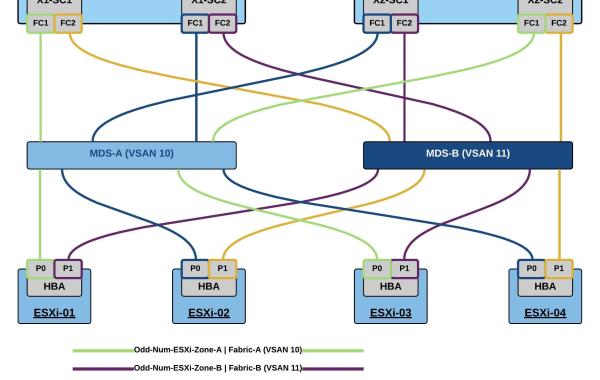
EMC XtremIO – Smart Zoning Example

The example provided is based on the following design:

  • Dual X-Brick Cluster
  • Cisco MDS Switches – Dual Fabric
  • VMware ESXi 4x Host Environment
  • 4 Smart Zoned Paths per ESXi Host (2 paths per Fabric)

ESXi in this scenario may depict a standalone host or a 4x cluster configuration (Scripts provided are based on a 4x Host basis). Balancing the ESXi Hosts between the XtremIO Storage Controllers is key for the design to provide a distributed workload across all the available Storage Controller target ports. The following example depicts a 4x Host configuration, in the event a 5th Host is required then it is advised to use a round-robin methodology (ESXi05 utilises ESXi01 zoning logic etc.).

The Smart Zoning feature is available with MDS 9000 series switches from NX-OS 5.2(6).

Some of the key benefits of using Smart Zoning:

  • Reduced configuration simplifying the zoning process.
  • Simplified addition of new ESXi hosts – add new ESXi member Host to a Zone and reactivate.
  • Eliminates single-initiator to single-target zones.
  • Reduced Zoneset size – multiple initiators and multiple targets zoned together.
  • Reduced number of Access Control Entries (ACEs).

Continue reading